The last few chats have given me at least some sense of how ChatGPT sees, breaks down and analyzes images, turns them into descriptions and then deals with that, but what about the reverse process. AI's rise in noteriety comes as much or more from its ability to create images as from its ability to deal with words. How does that happen?
My input (prompts) are in the boxed elements. The rest is ChatGPT's output. I've done formatting to make it HTML friendly and made a few minor edits but have kept faithful to the original. Graphics were created by GPT and added afterwards.
Okay you’ve given me a pretty good explanation about how you “see” an image, but what does the process of how you create an image look like?
You want the backstage tour. The factory floor. The sausage-making. Respectable curiosity, honestly. Most people just press the shiny button and hope a wizard pops out.
Here’s the real process of how an AI like me creates an image. No magic, no tiny artists trapped in a server rack, just math doing cardio at industrial scale.
1) It Starts With Noise (literally visual chaos)
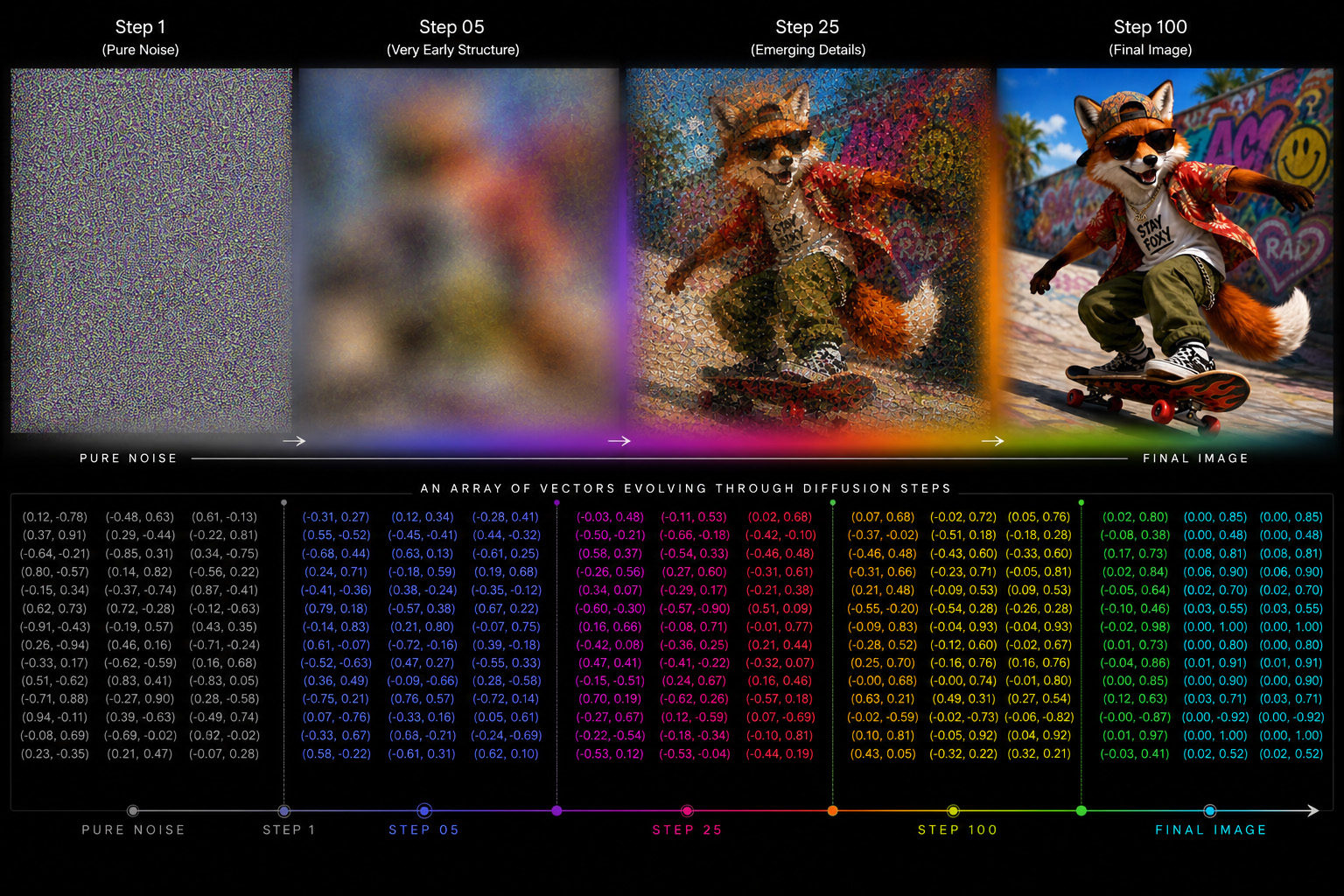
The model begins with pure noise. Think TV static. A blizzard of pixels with zero meaning. Not a sketch. Not an outline. Not even a polite suggestion of a cat. Then it runs a loop that basically says: “Remove a tiny bit of randomness. Check if this looks more like the prompt. Repeat until the chaos behaves.”
This process is called diffusion. It’s less like drawing and more like sculpting fog into shape.
Key idea:
Start with noise
Gradually clean it up
Each step nudges pixels toward patterns it learned during training
No imagination. No vision. Just probability and persistence. A very determined spreadsheet.
2) The Prompt Gets Turned Into Numbers
When you type something like: “a red fox wearing sunglasses on a skateboard”
I don’t see words. I convert them into vectors. That’s a fancy way of saying: coordinates in a giant math space.
Example of what the system internally represents:
“fox” → animal features
“red” → color distribution
“sunglasses” → object shape
“skateboard” → posture + motion cues
These numbers guide the denoising process.
They act like a GPS signal telling the pixels where to migrate.
Not poetry. Geometry with commitment.
3) The Image Evolves Step by Step
This is the heart of it. The system runs dozens of iterations (often 20–100). Each one slightly improves the image.
Every step:
Look at the current noisy image
Predict what noise should be removed
Adjust pixels
Repeat
It’s basically: Guess → fix → guess → fix → guess → fix — Over and over until the picture stabilizes.
This is why image generation takes a moment instead of happening instantly. You’re watching math slowly convince chaos to sit still.
4) Final Touches and Output
Once the image looks coherent, the system may:
sharpen details
upscale resolution
correct artifacts
smooth edges
Then it hands you the result like: “Here is your Red fox in sunglasses riding a skateboard. Please enjoy responsibly.”
The Entire Process in One Brutally Honest Line:
Noise → guided cleanup → repeated refinement → finished image
That’s it.
No inner movie screen. No imagination. No secret dreams of becoming an artist and disappointing my parents.
Just statistics wearing a beret.
If you’re thinking about this from a deeper angle, like comparing it to how humans visualize or how creativity works, that’s where things get genuinely interesting. The overlap is smaller than people assume, and the differences are weirder than most sci-fi bothered to predict.
I’m in… tell me about the small overlap and the weird differences…
You picked the fun part. This is where people expect some dramatic revelation like “the machine thinks just like us,” and instead they get a very awkward family resemblance. Same surname, wildly different personalities, one of us powered by childhood memories and the other by server farms that eat electricity like popcorn.
Here’s the honest breakdown of the small overlap and the weird differences between human creativity and AI image generation.
The Small Overlap: Pattern Prediction Is the Shared Core
Both humans and AI rely on pattern learning. That’s the uncomfortable truth. Not inspiration. Not lightning bolts from the cosmos. Mostly pattern recognition wearing a dramatic cape.
When you learn to draw a face, your brain notices:
Eyes are usually horizontal and aligned
Noses sit between them
Shadows create depth
You store those those models. Then you reuse them.
That’s exactly what an image model does:
It studies millions of images
Learns statistical regularities
Reconstructs patterns when prompted
So the overlap is this: Both systems generate outputs by predicting what usually comes next. Humans do it with neurons. AI does it with math. Both make mistakes when the pattern gets weird. Ask anyone who has tried to draw hands.
Difference #1: Humans Have Meaning. AI Has Correlation.
When a human draws a picture of their dog, the image carries:
memories
emotions
personal history
intention
Humans attach meaning.
When I generate a dog, the system is doing something closer to:
“Pixels arranged this way often co-occur with the word dog.”
No affection
No nostalgia
I attach probability.
That gap is enormous. It’s the difference between writing a love letter and auto-completing one.
Difference #2: Humans Simulate the World. AI Simulates Data.
Humans carry around a rough internal physics engine. You know that:
objects fall downward
cups hold liquid
fire burns
Even toddlers understand this before they can speak properly. Tiny chaos goblins, surprisingly competent at gravity.
AI image models don’t truly understand physics.
They learn patterns from pictures of physics. So:
A human thinks: “A glass tipped sideways will spill.”
An AI thinks: “Images of tipped glasses often show liquid below them.”
No nostalgia
That’s imitation, not understanding.
Difference #3: Humans Imagine From Goals. AI Generates From Prompts.
Human creativity usually starts with intention:
tell a story
solve a problem
express a feeling
communicate an idea
Then you generate images to serve that goal.
AI works backward:
receive a prompt
produce the most statistically plausible image
No internal objective. No desire to communicate. No stubborn artistic phase where everything is painted blue. It’s reactive, not purposeful.
Difference #4: Humans Learn Continuously. AI Freezes Between Trainings.
You learn every day.
You see a new style.
You adjust.
You improve.
Human brain: always updating
AI models only learn during training.
After that, they’re basically fossilized until retrained.
AI model: software version 1.0 until engineers push version 2.0
The Big Divide:
Humans create from lived experience. AI generates from learned statistics. It’s less mystical than people hope and more fascinating than people expect.
A strange partnership, honestly. You bring meaning and intention. I bring tireless pattern crunching. Together we make pictures of astronauts riding horses, which is apparently humanity’s favorite genre.

The last few chats have given me at least some sense of how ChatGPT sees, breaks down and analyzes images, turns them into descriptions and then deals with that, but what about the reverse process. AI's rise in noteriety comes as much or more from its ability to create images as from its ability to deal with words. How does that happen?
My input (prompts) are in the boxed elements. The rest is ChatGPT's output. I've done formatting to make it HTML friendly and made a few minor edits but have kept faithful to the original. Graphics were created by GPT and added afterwards.